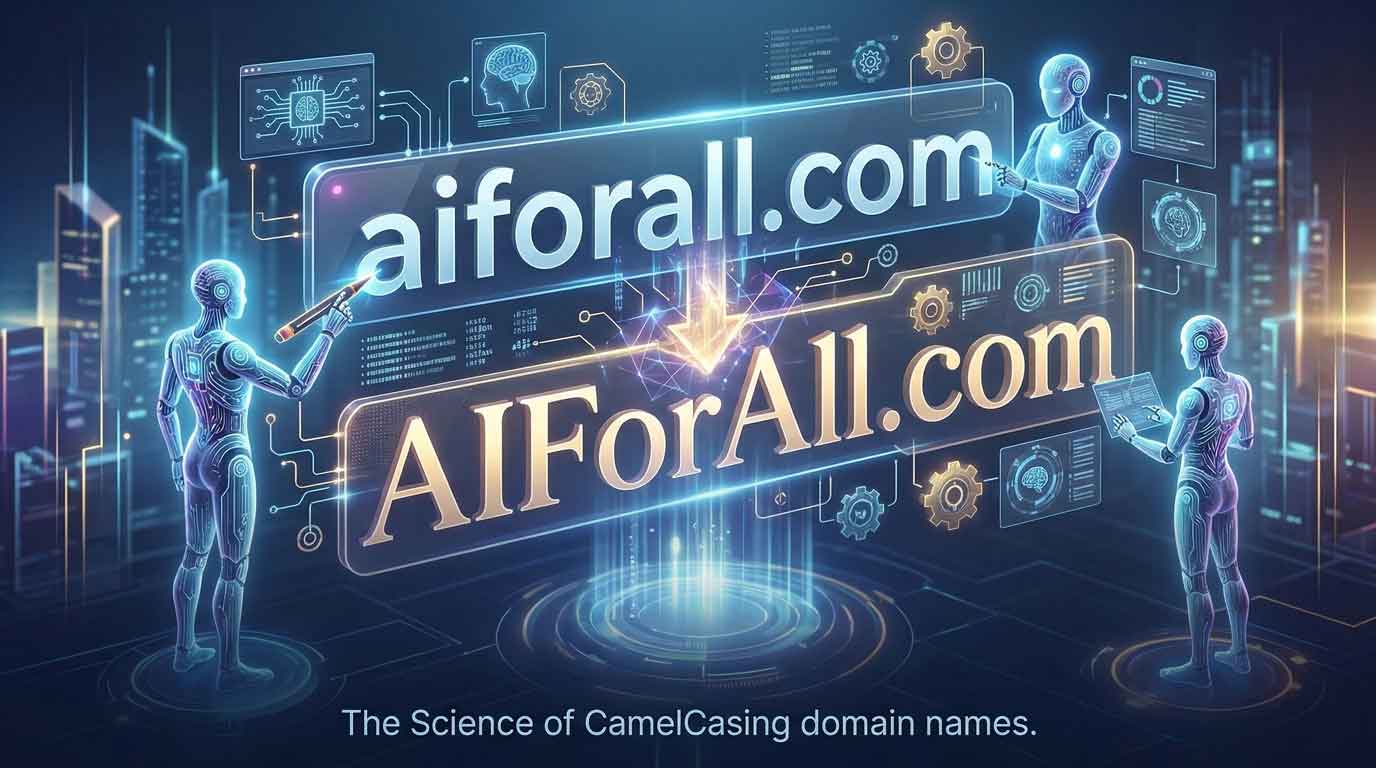
Solving Domain Display: The Science Behind How Appraise.net Restores Brand Casing
If you've used Appraise.net to appraise a domain recently, you may have noticed something small but satisfying: the domain name in your results looks... right. Consultify.com instead of consultify.com. NFTer.com instead of Nfter.com. AIForAll.com instead of Aiforall.com.
That's not an accident - we just overhauled how Appraise.net displays domain names to restore their intended brand casing.
The Problem With Displaying Domain Names
Domain names are stored and transmitted in lowercase. That's just how DNS works. But human branding lives in mixed case: CodeVault, BrandMentum, SmartifyNow. When you register a domain, the casing you intended gets stripped away the moment it hits a registrar.
For an appraisal platform, this matters. A domain's brandability is part of its value. Showing aigenicslabs.com when the intended brand is AIGenicsLabs.com undersells the asset. It also just looks sloppy.
The challenge is reconstruction. Given only the lowercase string smartifynow, how do you reliably get back to SmartifyNow?
How We Solve It: AI Segmentation + Rules-Based CamelCasing
Appraise.net uses a two-step approach.
Step 1: AI-powered word segmentation. Our system analyzes each SLD and breaks it into its constituent words and parts. consultify becomes consult + ify. nfter becomes NFT er. undistinguishable becomes Un Distinguish Able. This segmentation is stored alongside each domain in our database.
This step is what makes everything downstream possible. And it's harder than it looks.
Domain names borrow freely from across languages and cultures: a single SLD might blend an English root with a Latin suffix, an Arabic proper noun, a Japanese loanword, or a coined neologism with no linguistic home at all. Our segmentation model is trained to recognize word boundaries across all of these, not just English vocabulary. That breadth lets the CamelCasing layer do its job accurately. Even for names that seem like random strings at first.
Step 2: Deterministic CamelCasing. A purpose-built function reads the segmentation and reconstructs the display form by applying a clear set of rules:
- Acronyms (AI, NFT, XOR) stay fully uppercase
- Suffixes (-ify, -ness, -able, -ing, and dozens more) are lowercased and visually merged with the preceding word
- Everything else gets TitleCase
The result: BizTechify, Serverless, GeniumLab, AIForAll. Every AIForAll.com or CodeAbility.net looks like a brand again, not a system artifact.
The Suffix Problem (And Why It's Trickier Than It Sounds)
The trickiest part was suffix handling. English has a lot of them, and they behave differently depending on context.
Our suffix list covers 36 common morphological endings: -ify, -ly, -ness, -ment, -tion, -able, -ible, -ing, -ics, -ium, and more.
But a suffix should only be lowercased when it's genuinely attached to the preceding word, not when it happens to appear at the end. So we added a contiguity rule - meaning the suffix must directly touch the previous word in the original domain, with no separating tokens or breaks. A token is only treated as a suffix when it sits immediately adjacent to the previous token in the original SLD.
This means:
consultify→consult + ify→ Consultify (contiguous, ify lowercased)serverless→server less→ Serverless (contiguous, less lowercased)alsabah→Al Sabah→ AlSabah (gap between tokens, both capitalized)
Without the contiguity check, we'd get false positives everywhere.
A Tougher Edge Case: Trailing Single Letters
While auditing thousands of domains in our database, we found a pattern worth calling out: domains where AI segmentation ends in a single trailing letter. Think WizardE.com, BufferE.com.
These fall into roughly three buckets:
- Hyphenated or standalone initials - clearly intentional, fine as-is
- All-letter acronyms (like
APRZsegmented asA P R Z) - also fine - Adjacent trailing letters after real words - this is the murky zone
For that third group, we considered automatically lowercasing the trailing letter as a suffix - which would turn WizardE.com into Wizarde.com. But that same logic would corrupt legitimate brand names like CloudX, HeroesX, and GetZ, where the trailing letter is intentional. There's no reliable heuristic to tell the difference - it's a purely semantic judgment.
So we made a conservative call: leave them as-is. It's better to preserve an intentional brand name than to silently corrupt it.
What This Looks Like in Practice
Here's a sample of domains before and after the update:
| Domain | Display Result |
|---|---|
consultify.com | Consultify.com |
nfter.com | NFTer.com |
serverless.tv | Serverless.tv |
biztechify.com | BizTechify.com |
undistinguishable.com | UnDistinguishable.com |
aiforall.com | AIForAll.com |
codeability.net | CodeAbility.net |
smartifynow.com | SmartifyNow.com |
toplytics.com | TopLytics.com |
One worth noting: TopLytics.com. The suffix -lytics isn't in our list (only -ly is), so it gets TitleCased as its own word. Debatable, but correct per our current rules - and we'd rather be conservative than mangle a brand name.
Why It Matters for Domain Valuation
Brandability is one of the hardest things to quantify in domain appraisal. Memorability, pronounceability, visual appeal - these are real factors that influence what a buyer will pay. When Appraise.net presents a domain in its intended brand form, it helps both the appraiser and the end user see what the domain could be, not just what a DNS record says it is.
Every refinement to how we see a domain brings us closer to more accurate, human-aligned valuation.
This update affects thousands of domains in our system, and we're continuing to refine segmentation quality as part of our broader AI improvement pipeline.
If you've got a domain you'd like appraised, give it a try at Appraise.net.
Appraise.net is an AI-powered domain name appraisal platform serving the US aftermarket. Our valuations are built for English-language domains and the buyers and sellers who trade them.