What Makes a Good Domain Name Appraisal? What Should You Expect From an Appraisal Service in 2026?
If you own a domain name or are thinking about buying one, you've probably wondered: what is this thing actually worth? Maybe you inherited a domain from a family member, grabbed a name years ago and never used it, or found the "perfect" domain for your idea but the seller wants thousands of dollars.
It's a fair question, and a surprisingly hard one to answer well. The domain aftermarket is opaque, inconsistent, and full of conflicting signals. Automated appraisal tools have existed for years, but most of them are unreliable at best and misleading at worst. Some spit out a single number with no justification.
Others inflate values to upsell you on premium listings. Very few actually help you make a better decision about buying, selling, or holding.
So what does a good domain appraisal look like? And what should a modern appraisal service actually deliver? Let me walk through what matters, from methodology to output to the features that separate a real tool from a gimmick.
Start With the Right Goal
A domain appraisal should answer one question clearly: what is the current retail price range for this domain name?
Not a single magic number. A range - because domain sales are negotiated transactions with inherent uncertainty. Two reasonable buyers might pay very different prices for the same name depending on their use case, urgency, and budget.
The word "retail" matters too. Wholesale and liquidation values are a different exercise entirely. And "current" is key; domain markets shift. The .ai boom reshaped pricing for an entire TLD category almost overnight. An appraisal from two years ago may be meaningless today.
A credible appraisal service frames its output around this goal and is transparent about what it is and isn't estimating.
Why a Good Appraisal Matters if You're Not an Investor
If you're not a professional domain investor, a trustworthy appraisal still solves very practical problems.
-
If you're buying a domain, it helps you avoid overpaying when a seller throws out a random four- or five-figure asking price. You get a realistic retail range instead of guessing or relying on their story.
-
If you're selling a domain you already own, it helps you avoid underpricing a name that has real demand or holding out for fantasy numbers that scare away serious buyers.
-
If you're deciding what to do with a domain, it gives you a sense of whether you're sitting on a modest asset, a strong brand you should build on, or something that's effectively only worth its registration fee.
Think of a domain appraisal like a property valuation: it doesn't predict the exact final sale price, but it gives you a grounded, data-backed range so you can negotiate, budget, and plan with a lot more confidence.
Reasonable Assumptions: What a Good Appraisal Holds Constant
Every appraisal has to make assumptions. The question is whether those assumptions are sensible and clearly stated. Here's what a good service should assume:
The domain is a blank canvas. The appraisal reflects the name itself, not an existing website, traffic, SEO authority, or revenue stream. If someone has built a business on the domain, that's a separate valuation exercise entirely.
No clear trademark infringement. This is critical. A domain that reads like a household brand name might look valuable, but it's a legal liability. A good appraisal service should actively check for trademark conflicts and heavily penalize names that carry infringement risk. A domain worth $50,000 on paper is worth close to zero if it comes with a UDRP complaint.
Standard registration status. The domain is assumed to be available or held by a willing seller, not locked in a legal dispute, redemption period, or registrar hold.
Single TLD in scope. Appraising "example.com" doesn't assume you also own .net, .org, or .ai. Each TLD is evaluated independently.
Current market conditions, not speculative futures. The appraisal reflects what a domain would sell for today, informed by trends, not a bet on where an industry might be in five years.
English-primary, with multilingual awareness. The bulk of aftermarket activity is English-driven, but cross-linguistic appeal is a genuine value multiplier. A name that works cleanly in Spanish, French, or Mandarin has broader commercial reach, and a good appraisal should flag that.
How Do You Know the Appraisal Is Any Good?
This is where most services fall apart. Anyone can generate a number. The question is: can you trust it?
Here are the quality signals that matter:
Consistency
Similar domains should return similar valuations. If "BlueSky.com" appraises at $150K–$250K, then "ClearSky.com" shouldn't come back at $800 or $3 million without a very clear explanation. Consistency across comparable names is the single easiest way to test whether a model actually understands what it's doing.
Anchored to Real Sales
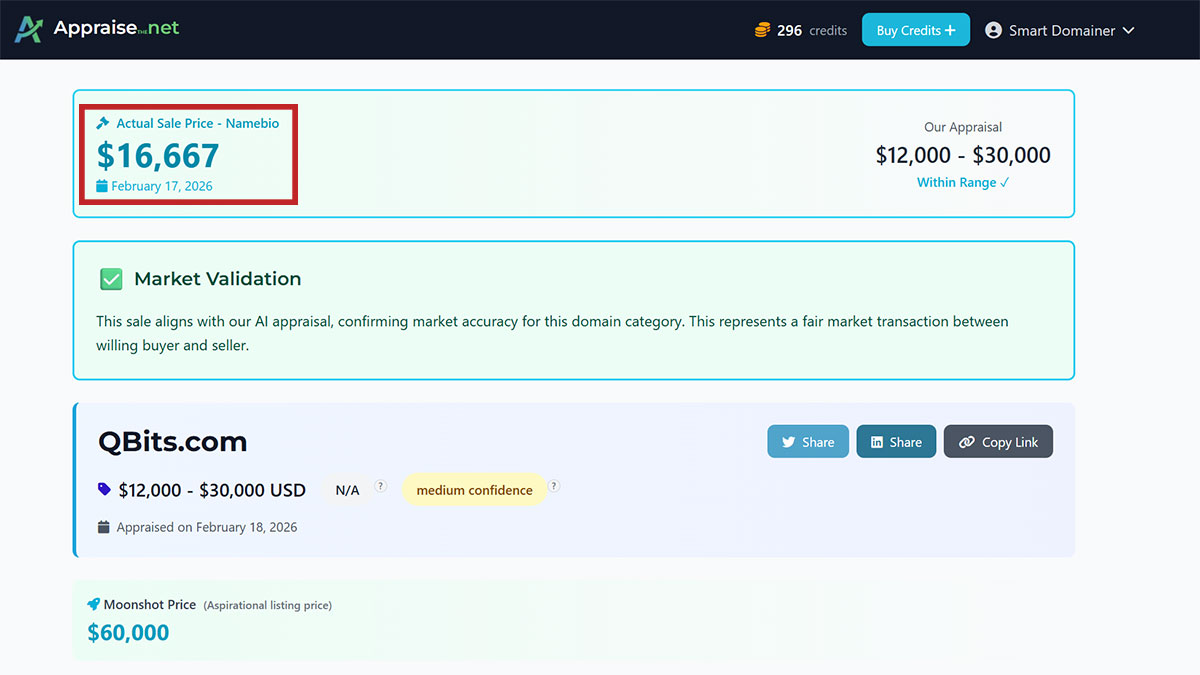
The appraisal range should be supported by actual comparable transactions: recent, verified sales of similar domains. A model that generates prices disconnected from market reality isn't an appraisal tool; it's a random number generator with a nice interface.
Transparent Methodology
Show the work. Which factors influenced the valuation, and by how much? Users should be able to understand why a domain is priced where it is, not just accept a black-box output on faith. This also builds trust: when a user can see that a name scored high on brandability but was penalized for length, they can evaluate whether the logic makes sense for their specific situation.
Reproducibility
Run the same domain twice, get a consistent result. This sounds obvious, but pure LLM-based approaches without structured scoring layers can produce wildly different outputs on repeat queries. A good service needs deterministic structure underneath whatever AI it employs.
Calibration Across Price Tiers
The service should be equally useful for a $500 domain and a $500,000 domain. Many models are tuned for mid-range names and fall apart at the extremes, either undervaluing premium one-word .coms or wildly overpricing mediocre long-tails.
Graceful Edge Case Handling
Numeric domains, IDNs (internationalized domain names), new gTLDs, hyphenated names, single-character domains - each category has different market dynamics. A good model doesn't just default to a generic formula; it adapts its approach based on what kind of name it's looking at.
What Should the Output Actually Include?
A price range alone isn't enough. A useful appraisal report gives you the context to act on the number. Here's what a complete output looks like:
Price Range
The core deliverable. A low-to-high retail estimate with confidence indicators.
Camelized Name
This sounds minor, but it's a genuine signal of quality: the service shows you the domain properly word-separated (e.g., "HealthRight" not "healthright"). It demonstrates that the system actually parses the name and understands its semantic structure, which directly affects how it scores brandability, readability, and memorability.
Semantic Type Classification
Is this a geographic name? A generic dictionary word? A brandable invented term? A numeric string? An acronym? The category fundamentally changes how the domain should be valued and marketed, and a good appraisal should classify it explicitly.
Multilingual Appeal
Does the name work across languages? Is it pronounceable in major markets? Does it carry unintended meanings in other languages? This is increasingly important as the global domain market matures.
Market Analysis
Where does this domain fit in the current market? What comparable names have sold recently, and at what prices? What trends in the relevant industry or TLD affect its value?
Analysis Factors and Scores
The detailed breakdown. A good appraisal should score the domain across multiple dimensions and show each score transparently:
- Length: character count and syllable count both matter
- Pronounceability: can someone hear it once and spell it correctly?
- Brandability: would a company build their identity around this name?
- Memorability: does it stick after one exposure?
- Semantic clarity: is the meaning immediately obvious, or is it ambiguous?
- Natural language quality: real dictionary word, clean compound, plausible coinage, or awkward string?
- TLD strength: how deep is the market for this extension?
- Keyword demand: search volume and CPC data as demand proxies
- Comparable sales: recent transactions for similar names
- Industry trends: is the relevant sector hot, stable, or cooling?
- Trademark risk: active check, not just an assumption
Secure Certificate
A timestamped, verifiable appraisal document that can be shared with buyers, used in negotiations, or referenced in brokerage listings. This turns the appraisal from a curiosity into a professional tool.
Service Functionality: From Casual Lookup to Professional Workflow
Different users need different things from an appraisal service. The functionality should scale accordingly.
Basic: Quick and Anonymous
Sometimes you just want to know what a domain is worth; quickly, without creating an account or handing over your email address. A good service should offer guest access for single appraisals. No login required, no friction, no data collection. You type in a domain, you get a result.
This matters more than most services acknowledge. Domain investors researching acquisition targets don't always want a paper trail. Sellers checking their own names want a fast sanity check, not an onboarding flow. Anonymity and speed should be the default experience.
For single domains or small batches, this is all most people need.
Advanced: Secure Sign-In and Persistent Tools
For professionals managing portfolios, the value unlocks when you sign in. A secure account gives you:
- Appraisal history: every domain you've appraised, tracked over time, with the ability to see how valuations have shifted
- Portfolio management: organize your domains into collections, tag them, track aggregate portfolio value
- List management: upload and manage domain lists, run bulk appraisals, sort and filter results
- Pricing strategies: set floor prices, asking prices, and make-offer thresholds based on appraisal data
- Batch processing: appraise thousands of domains efficiently with volume pricing
- API access: integrate appraisal data into your own tools, registrar platforms, marketplace listings, or custom workflows
The key insight is that the anonymous guest experience and the authenticated professional experience should feel like the same product at different depths, not two separate tools bolted together.
The Bottom Line
A domain appraisal is only as useful as the methodology behind it and the transparency of its output. The industry has been plagued by tools that either oversimplify (here's a number, trust us) or overcomplicate (here's a 40-page report full of jargon that doesn't help you price your domain).
What the market actually needs is something in between: a clear retail price range, backed by real comparable sales, with transparent scoring across the factors that actually drive domain value, delivered fast enough to be useful and detailed enough to be credible.
The best appraisal isn't the one that tells you your domain is worth a million dollars. It's the one that helps you understand what it's actually worth, and why, so you can make a smart decision about what to do next.