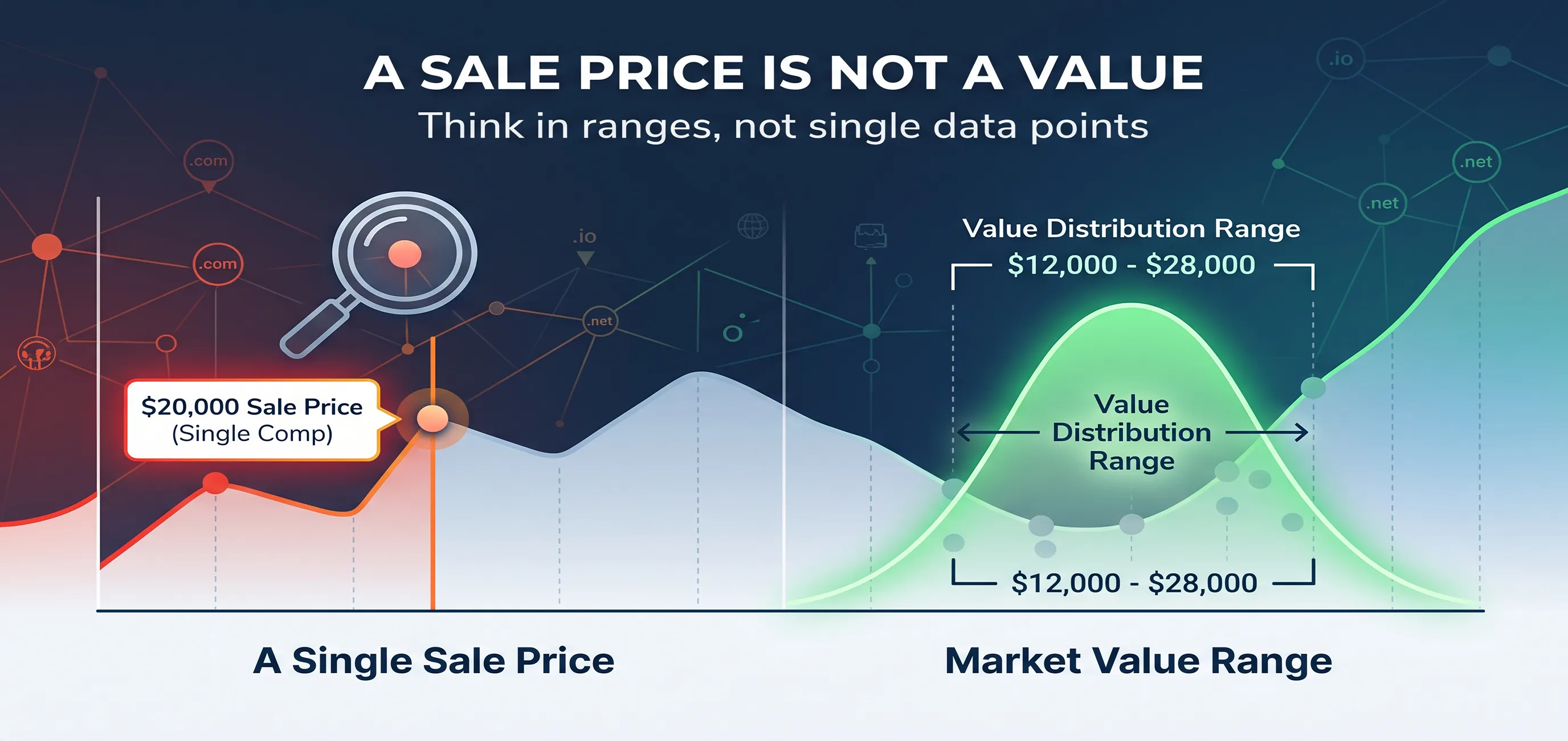
A Sale Price Is Not a Value
Every domainer has done it. You're pricing a name, you open NameBio, you find one comparable sale, and you treat that number like a verdict handed down from the market itself.
It isn't. A sale price is a single data point: one buyer, one seller, one moment, one set of circumstances. Value is the distribution those data points are drawn from, and a single sale tells you almost nothing about its shape.
The same number means different things
Consider a domain that sold for $20,000. That sounds like a clean, confident comp. But ask the question one layer deeper: who bought it, and why?
- The end-user. A funded startup might happily pay $20,000 because the name matches their product exactly and saves them years of marketing friction. To them it isn't a speculative buy, it's operational infrastructure, and it's cheap next to what they'll spend building the brand on top of it.
- The investor. A domainer looking to flip the name for a profit would be reckless to pay $20,000 for it. There's no margin left on the bone, and no guarantee another end-user with that exact need shows up before the capital is tied up for years.
Same domain. Same price tag. Two completely different contexts. The sale tells you what one motivated buyer was willing to commit. It does not tell you what the next buyer will pay, and it certainly doesn't dictate your floor price.
This is why the biggest, most-cited sales are often the least useful comps. A six-figure headline sale is almost always an end-user acquisition: a company paying top-tier retail to secure a brand it will build a business on. That's a real number, but it's a ceiling set by a buyer with a budget and a need that most of your future buyers won't share.
You can see this directly in the data. If you take thousands of real sales and group them by what the names are worth, the spread of actual prices widens the more valuable the name gets:
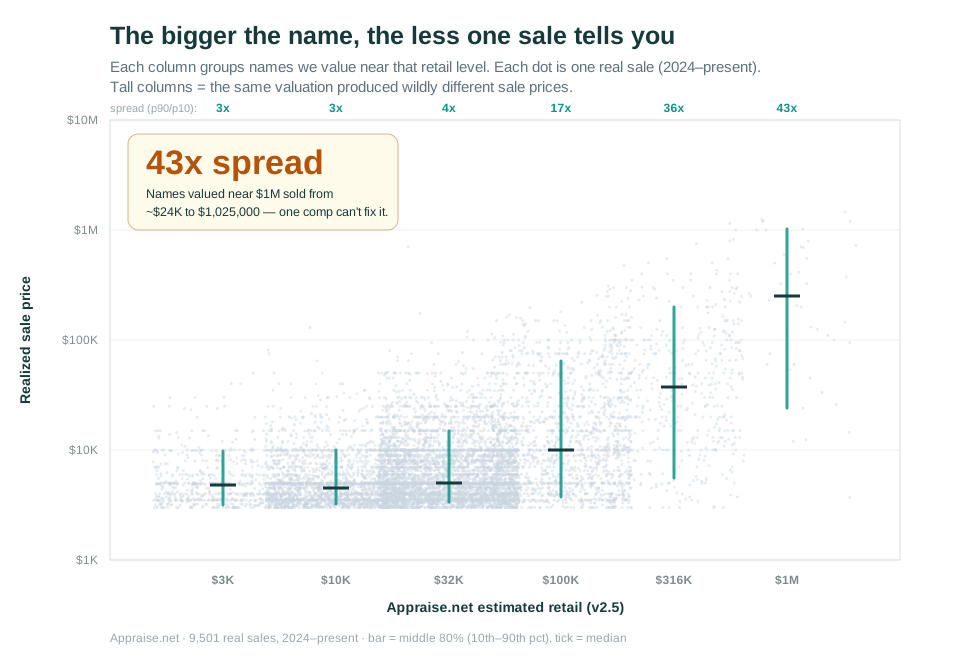
Each column holds names of roughly the same value, and the dots are what they actually sold for. At the low end the prices cluster tightly. At the high end they fan out across a 40x range. So the single comp you were about to lean on, especially a big one, is one dot in a very tall column.
What an appraisal is actually answering
A good appraisal isn't trying to guess the price of the next outlier transaction. It's answering a more useful question:
What is the retail range a qualified, rational end-user would pay for this name, on its best realistic use case?
That's a fundamentally different target than "what did one buyer once pay." It's a reference range you price from, not a single historical anchor you price to.
Capturing that range cleanly and consistently, across millions of very different names, is the hardest problem in domain valuation. It's exactly the problem we set out to solve with Engine v2.5: grade each name on its own merits, its structure, its extension fit, its realistic commercial use case, rather than letting one lucky (or unlucky) comp dictate the answer.
Read comps as evidence, not as the answer
None of this means sales data is useless. The opposite: it's the most important evidence we have. But evidence has to be weighed, not just cited.
- A cluster of recent sales in a tight range is strong signal.
- A single six-figure sale by a motivated end-user is weak signal for the broader market.
- An old sale from a different market cycle is barely signal at all.
The skill, and it is a skill, is knowing which comps to trust, how much, and for whom. That's the work an appraisal should do for you, and it's the work most "look up one comp" approaches skip entirely.
A sale price tells you that someone, once, paid that. A value tells you what to expect. Don't confuse the two, and don't let a single number from a stranger's transaction price your portfolio.
Next in this series: The Tyranny of $2,999, on why so many very different domains sell at the exact same price, and how that quietly distorts the comps you rely on.