What a Good Sale Actually Looks Like
We hear a version of this regularly:
"Your engine appraised my domain at $3,000, but it sold for $1,200. So the appraisal was wrong, right?"
That reaction makes complete sense. The number looked like a target, the sale came in well under it, and it feels like you left $1,800 on the table. But once you understand what the appraisal actually represents, you'll see that $1,200 was a perfectly good sale. The confusion comes from reading the appraisal as a price tag. It isn't one.
Your appraisal is a retail range, not a list price
Engine v2.5 gives you an estimated retail range, for example $2,500 to $3,500. The top of that range is your retail ceiling: the best-case price a qualified, rational end-user would pay for the name on its best realistic use case, in a patient, one-off negotiation.
That ceiling is a reference you price down from, depending on how fast you need to move and how long you're willing to wait. It is deliberately not:
- a median sale price,
- a guarantee,
- or a list price you should slap on and refuse to budge from.
Most domains sell below their retail ceiling, and that's completely normal. Sell-through rates across investor portfolios are famously low, often well under 2% a year. The entire game is converting illiquid inventory into cash at a speed and price that work for you.
The 10-100% rule: wholesale to retail
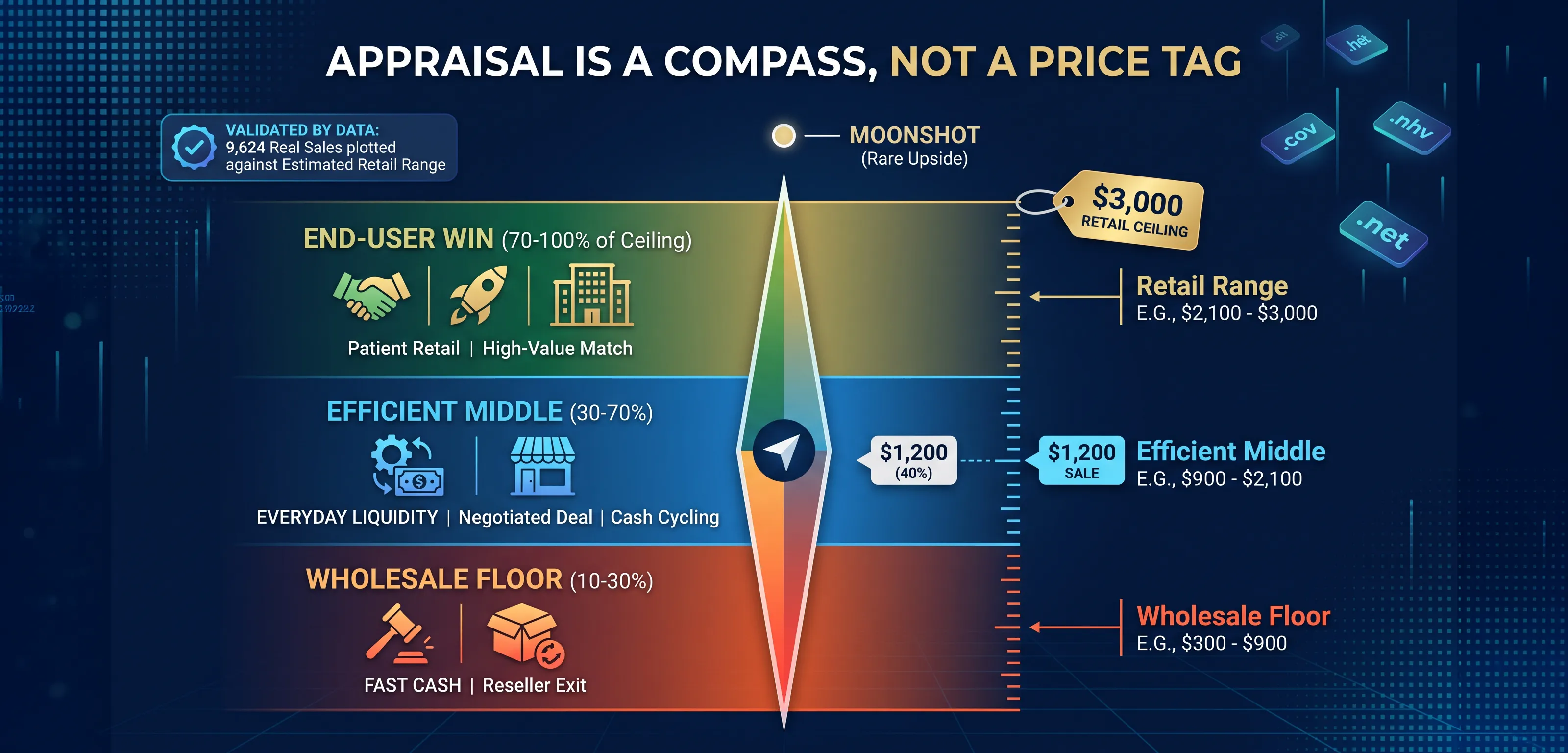
Here's a more useful way to judge an outcome, measured against your retail ceiling. A sale anywhere from roughly 10% to 100% of that ceiling can be a respectable result, but who you sold to and how fast decides what kind of result it is:
- ~70-100% (the end-user win). You found a motivated, qualified buyer who needed the name and paid close to full retail. Excellent.
- ~30-70% (the efficient middle). A negotiated retail deal, or a discount to a well-funded buyer to close quickly. This is the everyday liquidity a healthy portfolio runs on.
- ~10-30% (the wholesale floor). A reseller or liquidation price, the kind you see at expired auctions or in a quick flip to another domainer. For a lower-tier name you wanted off the books to free up capital, that's a successful wholesale exit, not a failure.
The key is knowing which zone you're actually in. A 15% sale on a name you needed to liquidate is a win. The same 15% sale on a strong name you sold in a hurry means you just handed an end-user's margin to a reseller. The percentage alone doesn't tell you whether you did well, the context does.
That $3,000-ceiling name selling for $1,200 is 40% of retail: squarely in the efficient middle. That's not a miss. That's the system working, keeping your capital moving.
This isn't just theory. When we plot thousands of real sales against their estimated retail range, the overwhelming majority land inside that 10-100% good-sale zone, with only a small minority of moonshots punching above the ceiling:
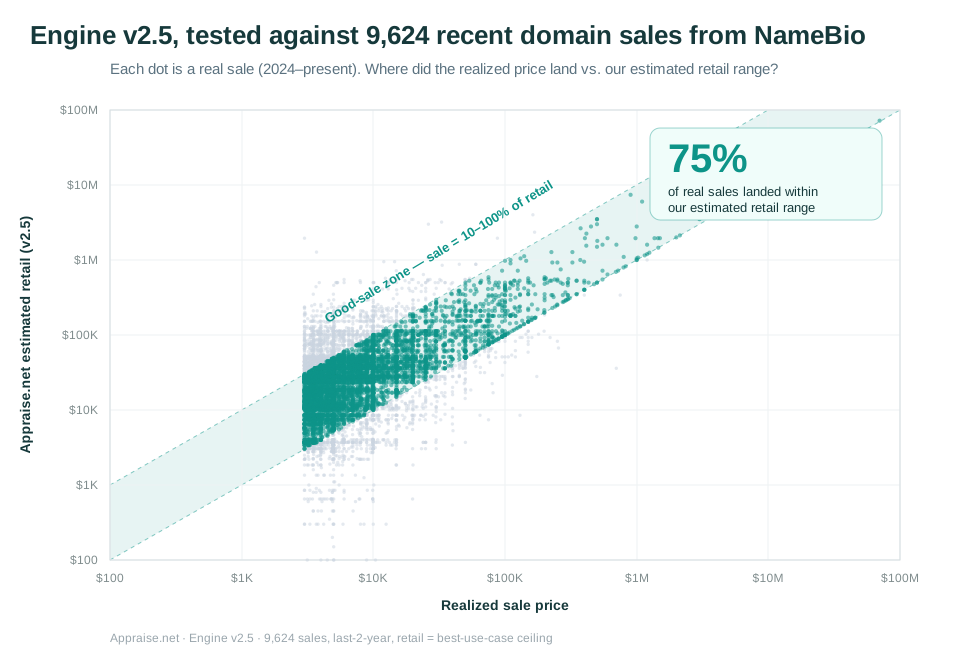
Seen this way, a sale below your ceiling isn't the engine being wrong. It's where the vast majority of healthy sales are supposed to land.
Not every domain should ask high retail
This is where strategy comes in, and where the appraisal becomes a tool instead of a verdict. The right asking price depends on the tier:
- Lower-tier names thrive on liquidity. Price them closer to the bottom of the range, sell more of them, keep the cash cycling. Asking full retail on a starter brandable just means it never moves.
- Higher-tier names reward patience. The better the name, the more justified a higher ask, because the qualified end-users exist and are willing to pay for quality. Here, holding out near the ceiling makes sense.
Match the price to the name and to your own strategy. The appraisal gives you the ceiling; you choose the haircut.
And then there's the moonshot
You'll also see a moonshot price on your appraisal, a figure well above the retail range. That's not a typo and it's not the number to list at. It's the rare upside ceiling: the result that top-tier domainers occasionally capture when the perfect buyer, with the perfect need, shows up at the perfect time.
It happens. It's real. But it's the exception, achieved by people positioned to wait years for a single buyer. Treat it as the high end of what's possible, not the price to expect, and never price an entire portfolio as if every name will moonshot.
Use the number as a compass, not a price tag
Put it together and the appraisal stops being a thing you argue with and becomes a thing you steer by:
- The retail range sets the ceiling you price down from.
- The 10-100% rule tells you what success looks like at each level, wholesale to retail.
- Your tier strategy tells you where to actually price.
- The moonshot tells you what's possible on a great day.
A good sale isn't "I got my appraisal number." A good sale is "I converted the right name, at the right speed, to the right kind of buyer, for a price that made sense." Most of the time, that lives well inside the range, and that's exactly how it should be.