The Tyranny of $2,999
Scroll through any month of domain sales and you'll see the same numbers over and over: $2,999. $4,888. $9,888. $1,995. They repeat so often they start to look like natural prices, as if the market had carefully discovered that these particular domains are worth exactly these particular amounts.
They didn't. Those numbers aren't valuations. They're sales tactics, and if you price your portfolio off them without understanding that, you'll quietly hurt yourself.
Why everything clusters under the round number
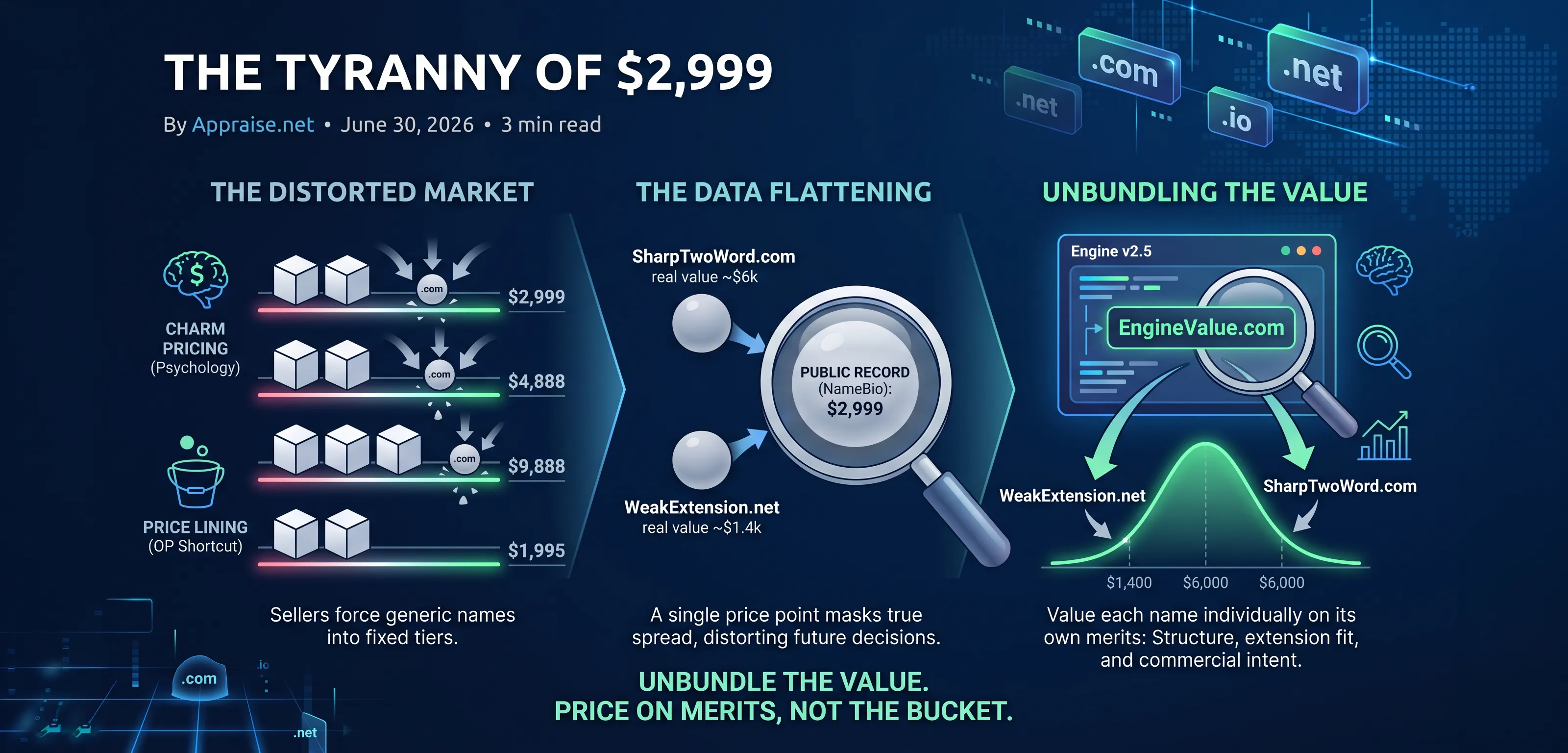
What you're seeing is two old retail strategies working together: charm pricing and price lining.
Charm pricing is the psychology. $2,999 feels meaningfully cheaper than $3,000, even though it's a single dollar. That's why the prices end in 9s and 8s.
Price lining is why you see it at scale. Marketplaces, brokers, and portfolio investors group vast amounts of inventory into a small set of fixed price tiers, so they don't have to value each name individually. It's an operational shortcut: if you're moving thousands of names, you don't agonize over whether a domain is objectively worth $2,400 or $3,300, you just drop it in the "$2,999 bucket" and move on.
Multiply that shortcut across the whole industry and you get a market where genuinely different domains all transact at the exact same handful of price points.
The hidden cost: the comp record gets compressed
Here's the part that matters for you. When two names both sell for $2,999, the sales record says they're equal. But they're usually not:
- One might be a sharp, brandable two-word .com that a patient seller underpriced to move it fast. Its real ceiling was $6,000.
- The other might be a weaker name that got lifted into the bucket because $2,999 is just where that seller prices everything. Its honest value was $1,400.
NameBio records them both at $2,999. Price lining flattened a real spread into a single number, and anyone pricing off that comp inherits the distortion. You'll tend to under-ask on your good names (anchored to the bucket) and over-ask on your weak ones (lifted to the bucket). Both cost you money.
This is why naive comp-matching is so unreliable for the mid and lower tiers. The comps aren't lying, exactly. They're just bundled. The price you see is the tier's price, not the domain's value.
Unbundling is the whole job
A proper appraisal has to do the thing the marketplace deliberately skipped: value each name individually. Not "what tier did a seller lump this into," but "what is this specific name worth, on its own merits?"
That's a big part of what Engine v2.5 is built to do. We look at the structure of the name, the fit between the words and the extension, the realistic commercial use case, and how comparable individual names (not comparable price buckets) have actually performed. The goal is to hand back the spread that price lining erased: to tell you that your $2,999-bucket name is really a $6,000 name, or really a $1,400 name, so you can price it like what it is.
What to do with this
- Ignore the round number. $2,999 tells you which bucket a seller reached for, not what the name is worth. Anchor to the name, never to the barrier.
- Judge the name on its own metrics. Length, word strength, extension fit, commercial intent, real demand. Those are what drive value. The price tier a name once sold in does not.
- Let the appraisal do the heavy lifting. Valuing each name individually against the right signals is exactly what an engine is for, especially across a portfolio far too large to hand-analyze one name at a time.
The barriers are a seller's convenience. Don't mistake them for the market's verdict, and don't let your best names hide inside someone else's $2,999.
Next in this series: What a Good Sale Actually Looks Like, on how to read your appraisal and tell a genuinely good sale from a missed one.